As the pharmaceutical industry works to stay ahead of rapid advancements in drug development, critical pharma applications such as compounding pharmacies, pharmaceutical manufacturing and pharmaceutical distribution rely more and more on flexible cold storage as an indispensable part of their production models.
But while the temperature-sensitive product market has a compound annual growth rate (CAGR) of over 9%, it faces a variety of obstacles that threaten product integrity and operational efficiency, including:
- Supply chain disruptions. Customs delays, transportation bottlenecks, accidents, or natural disasters can result in temperature excursions costing up to billions of dollars.
- Sustainability concerns. The temperature-sensitive product market is expected to grow up to 60% over the next decade, making energy efficiency essential to maximizing profit while reducing environmental impact.
- Regulatory and compliance pressure. Pharmaceutical and life sciences organizations are required to provide validation, temperature mapping, and continuous monitoring documentation, but achieving compliance in flexible setups can be resource intensive. (For more information, see our guide to pharmaceutical cold rooms validation & compliance)
- Perishable, high-value products. Temperature-sensitive pharmaceuticals make reliable redundancy and rapid response protocols an essential part of any compliant cold storage strategy.
- Capacity and scalability constraints. Fluctuating demands from new therapies or market trends can exceed the limits of permanent infrastructure during peak production times. This can become more complex when issues, such as custom needs and space limitations, are thrown into the mix.
Added to these market concerns are the unique requirements of each individual application, all of which are typically more challenging than food-grade cold storage. The challenge lies in finding solutions that can:
- Alleviate market concerns
- Meet each application’s requirements
- Scale quickly to adapt to fluctuations in materials and inventory
- Avoid the high upfront costs of expensive infrastructure
Let’s take a closer look at each of these applications and their specific challenges.
Compounding pharmacies
Precision and consistency are the cornerstone principles of compounding pharmacies. These fast-paced operations are responsible for preparing a wide range of customized medications for patients and healthcare providers. Some of these formulations must be kept within strict temperature limits (2–8°C or frozen) to protect product safety and efficacy.
Cold storage systems used by pharmacies must maintain tight temperature tolerances despite frequent door openings, rush periods, and cleaning cycles. Compounding pharmacies need to produce detailed documentation of temperatures to achieve compliance with regulatory and quality assurance standards. Reliable, audit-ready cold storage helps them operate efficiently and stay compliant with every batch they produce.
Compounding pharmacies require records that fit pharmacy SOPs, including:
- IQ/OQ/PQ support
- mapping summaries
- calibration certificates
- secure data exports
Reliability and contamination control for compounding pharmacy cold storage
Because their high-value inventory can be compromised by even short excursions outside of their specified temperature range, walk in coolers and freezers for compounding pharmacies must be extremely reliable, with minimal downtimes and the ability to be replaced quickly. They also need to have surfaces that stand up to robust cleaning protocols, tolerating pharmacy disinfectants and minimizing bacterial growth.
Pharmaceutical manufacturing
Pharmaceutical manufacturers handle materials ranging from raw ingredients to finished products, such as biologics, MRNA vaccines, and CGTs needing ultra-cold conditions down to -70°C. Because many of these can lose integrity during even brief excursions outside of their specified temperature ranges, having reliable walk in refrigeration is essential to ensuring product stability and efficacy.
The manufacturing process has many variables that change with production, including throughput and frequency of product access. Walk in coolers and freezers need to maintain tight temperature tolerances through changing loads and door cycles as demand spikes and diminishes, supply inventories build and are depleted, production scales, and other factors change. The production environment requires energy-efficient walk ins with an easy-to-clean, sanitary design that can deploy quickly and seamlessly integrate with fast-paced workflows.
Manufacturing environments demand cGMP storage that drops cleanly into batch records and satisfies QA, including:
- IQ/OQ/PQ support
- temperature mapping summaries
- calibration certificates
- secure logs
- exportable data that aligns with 21 CFR Part 11 expectations
Pharmaceutical distribution
In pharmaceutical distribution, cold rooms are often used to pre-condition gel packs or phase-change materials (PCMs) before they’re placed into insulated shippers. Although these materials aren’t damaged by temperature excursions, all packs and PCMs need to reach the same verified temperature in order to maintain the proper environment for the products they protect during transit.
To ensure that every gel pack or PCM conditions evenly even during busy shipping windows, the cold room must have uniform airflow to prevent hot and cold spots. Temperatures must also recover quickly after door openings. Once shipments reach the pack-out stage, they are assembled with products in finished totes or pallets and typically held near the loading dock until pickup.
Reliable temperature control and clear, continuous documentation make it easy for teams to confirm that the space is performing as intended and that outbound shipments are being prepared under stable, validated conditions.
Because distribution centers are tightly regulated, they require storage that supports good distribution practices, continuous monitoring, and rapid deployment to handle surges or new routes. Reliable, validated cold rooms help keep the flow of medicine safe, compliant, and on schedule.
Distributors also audit-ready documentation, including:
- IQ/OQ/PQ support
- temperature mapping summaries
- calibration certificates
- secure records consistent with 21 CFR Part 11 expectations
Enhancing cold chain efficiency in pharmaceutical distribution
High-throughput cold staging areas located near pharmaceutical distribution center loading docks keep products within required temperatures while shipments are assembled or transferred. These portable cold room units are typically positioned at ground level adjacent to the dock, allowing quick pallet-jack access via ramps or lifts. This convenient layout plays a key role in preventing bottlenecks and supporting different workflow models.
These portable cold rooms can also store cross-docking shipments unloaded from inbound trucks until outbound trucks arrive. This flexibility allows the creation of open layouts that streamline product picking, packing, and palletizing for pick-and-pack operations. And clear labeling and open flow paths help ensure that products nearing expiration get out first in First-Expiry, First-Out (FEFO) processes.
By aligning cold storage placement and design with workflows, facilities can maintain temperature integrity, eliminate bottlenecks, and improve dock-side efficiency during high-volume shipping windows.
Walk in cold storage for blood & plasma banks
Blood and plasma banks handle some of the most temperature-sensitive materials in healthcare, and separate walk in coolers and freezers are ideal for storing delicate components at their ideal temperatures. Red blood cells require storage at 1–6°C, while plasma products must be kept at –18°C (or as cold as ≤ –30 °C for frozen storage) to preserve viability and ensure patient safety.
These banks face rigorous regulatory requirements, needing detailed documentation and constant movement of products between quarantine, processing, and release. To stay compliant, cold storage solutions must also maintain precise temperature tolerances and provide provable temperature uniformity across products.
Blood and plasma banks require alignment with applicable component requirements and Good Storage/Distribution Practices, plus audit-ready files that include:
- IQ/OQ/PQ support
- temperature mapping summaries
- calibration certificates
- secure electronic records compatible with 21 CFR Part 11
Separation and traceability in blood and plasma banks
Walk in coolers and freezers are an important part of purpose-designed facility layouts in blood and plasma banks that support clear material flow and strict chain-of-custody controls. In an ideal setup, sensitive products are stored in distinct zones for quarantine and release. This physical separation prevents accidental crossover and ensures that all goods stay in the designated quarantine zone until safety tests are complete. Approved products are then released and stored separately.
Placing walk in coolers and freezers set at different internal temperatures near loading docks allows incoming and outgoing products to be segregated and transferred quickly, minimizing exposure to ambient temperatures. Following best practices for zoning and layout strategies helps blood and plasma facilities maintain traceability and regulation compliance.
Research and university laboratories
Research and university labs depend on stable, versatile cold storage to support a variety of projects from life science research to clinical trials. This diversity of focus requires balancing shared access and providing consistent, validated temperature control (typically across 2 to 8°C and frozen storage) no matter how much loads fluctuate.
Whether preserving samples, reagents, or experimental materials, labs must also meet quality assurance and grant or sponsor audit expectations. These facilities require uniform temperatures without hot or cold spots, fast recovery after door openings, and required documentation.
Research and university labs require records that drop cleanly into lab QA files or sponsor or grant audits, including:
- IQ/OQ/PQ support
- temperature mapping summaries
- calibration certificates
- secure electronic records that align with 21 CFR Part 11 where applicable
Modular cold storage for campus and lab environments
Research and healthcare campuses need cold storage solutions that integrate smoothly into existing workflows and spaces. Walk in freezer or cooler units with quiet electric operation can be conveniently positioned close to loading docks or core labs, saving time while minimizing disruption in shared workspaces.
Walk ins must have durable, easy-to-clean interiors that can stand up to routine cleaning with disinfectants used in regulated spaces, supporting layouts that prevent cross-contamination and promote segregation between quarantine, active-use, and outgoing samples. Portable cold storage systems also simplify logistics across multi-building campuses, allowing facilities to expand capacity to meet demand.
Adaptability and future-proofing
Compliant cold storage includes product management, digital integration, and forward-thinking strategies. Temporary walk in cooler and freezer units can be a valuable part of this model, but they must be ultra-efficient while supporting real-time data for audits and excursions.
Scalable, energy-efficient designs align with sustainability goals, help reduce your carbon footprint, and ensure compliance. They also easily integrate into existing infrastructure without requiring excessive modification, which can help companies across the industry prepare for further growth in personalized medicines and meet global distribution challenges.
How Polar Leasing enhances pharmaceutical cold storage flexibility
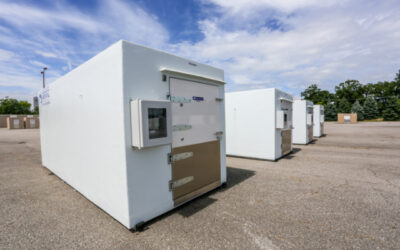
Polar Leasing offers pre-validated temporary onsite cold storage units engineered for the dynamic requirements of the pharmaceutical industry. Our walk in cooler and freezer rental units offer effortless scalability and compliance without the need to invest in permanent infrastructure. With rapid delivery and plug-and-play setup, our ultra-efficient freestanding structures provide compliant outdoor refrigeration that integrates effortlessly into pharma operations.
Polar Leasing offers:
- Precise, redundant control. Our advanced systems maintain tight temperature tolerances, with optional backup mechanisms to prevent failures.
- Remote temperature monitoring. We track a range of data points, including real-time temperature, door openings & closings, and defrost cycles.
- Audit-ready qualification documentation. We provide comprehensive documentation to simplify your onsite validation process.
- Cleanroom-friendly construction. Hygienic, seamless interiors make it easy to achieve USP compounding and contamination-control compliance.
- Manufacturing scalability. We have a range of sizes to accommodate stockpiling of materials or spikes in demand, protecting products at every stage of production.
- Uniform cooling. The balanced airflow in our pharmaceutical walk in cooler and freezer rental units creates consistent conditions without hot or cold spots.
- Flexible placement. We can place our walk in coolers or freezers on a variety of surfaces, allowing you to choose the location that best fits your needs.
- Sustainable efficiency. All units feature thick polyisocyanurate rigid board insulation completely encapsulated in durable fiberglass. This patented process makes Polar Leasing units the most efficient walk in cooler and freezers on the market.
Want to find out how Polar Leasing’s walk in coolers and freezers can help your pharmaceutical or life sciences organization? Contact us.