If you’re a pharmaceutical company searching for cold storage solutions, you’ve probably come across repurposed shipping container rentals, also known as reefers, marketed as a simple solution for storing temperature-sensitive ingredients and products.
Reefer containers were designed for maritime transport, not for stationary storage of high value pharmaceuticals aligned with Good Manufacturing Practice (GMP)/Good Distribution Practice (GDP).
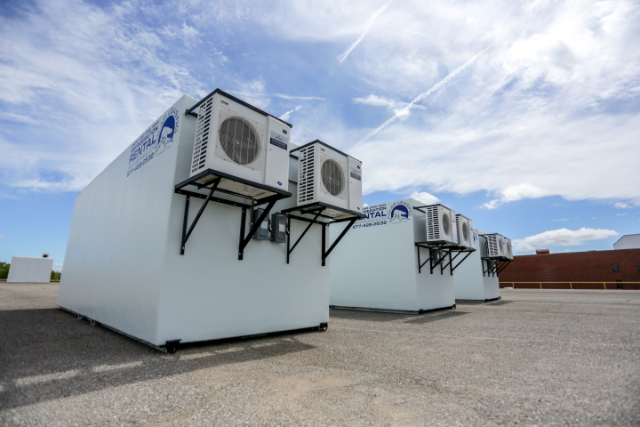
Walk in refrigeration units designed specifically for stationary and compliant pharmaceutical storage, on the other hand, are a more reliable and efficient choice for pharma environments. They’re also the more cost-effective option once associated costs are considered.
The following comparison can help you and your pharmaceutical team compare the strengths and weaknesses of walk ins versus reefer containers, so you can make the best choice for protecting your temperature-sensitive materials.
Reefer containers: built to stand up to shipping challenges
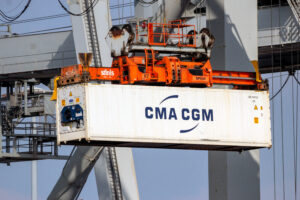
Refrigerated shipping containers are engineered to withstand a wide range of punishing conditions as they transport cargo. They’re lifted on and off ships and trucks by cranes, stacked up to 9 units high, and subjected to constant motion at sea while cargo shifts and distributes weight. Containers are built to tolerate the dynamic forces of waves coming from all directions, salt spray, and high humidity throughout transit.
While they perform admirably well in these conditions, the very characteristics that make them well-suited to these tasks make them less than ideal for stationary pharmaceutical cold storage.
Why reefers struggle in pharmaceutical settings
Many pharmaceuticals, from temperature-sensitive clinical trial materials and Active Pharmaceutical Ingredients (APIs) to vaccines and biologics, have a narrow stability range and must be constantly maintained within strictly controlled storage conditions. Even minor excursions can compromise product quality, interrupt supply, and trigger expensive investigations.
Pharmaceutical cold storage requirements include:
- Precise setpoints with tight tolerances
- Uniform temperature distribution without hot or cold zones
- Smooth hygienic surfaces free from cracks and open joints
- Compliance with GMP and GDP requirements
- Continuous monitoring with audit-ready data
- Predictable, qualifiable equipment performance
Built for cargo transport, shipping containers are not optimized for medication storage, sample staging, clinical trial material, or biologics.
Walk in refrigeration vs. reefer containers: pharma-specific differences
Now that we’ve seen where walk-in refrigeration units and reefer containers excel, let’s take a closer look at how they compare for compliance, performance, and operational factors. These differences have a direct impact on qualification timelines, risk exposure, and long-term cost.
Power requirements: Reefer containers need high voltage
Although shipping containers are often marketed as simple solutions, reefer power requirements make installation challenging. That’s because they’re designed with high-capacity blowers and aggressive airflow to counter the heat load from cargo stacked to the ceiling and handle changing temperatures.
| Pharmaceutical refrigerated containers: | Polar Leasing pharma walk in rentals: |
| · Often require 380–460 V, 3-phase power | · Operate on 230 V, 30A single-phase power |
| · May operate on 440/460/480 V | · Arrive ready to go with a simple electric connection |
| · Require risky step-up transformers if high-voltage service is not available | · Don’t require transformers, rewiring, or electrical upgrades |
Pharmaceutical refrigerated containers are designed to run on high-voltage industrial power, which creates a major barrier in pharmaceutical settings where outdoor areas and temporary staging zones rarely offer that level of electrical service.
Polar Leasing’s ultra-efficient pharmaceutical walk in coolers and freezer rentals are both easy to deploy and cost efficient to run.
Mobility: Walk in rentals are lighter, easier, and safer to deploy
Because reefer containers for pharmaceuticals are subject to high levels of structural strain from repeated crane lifts, stacking, extreme changes of weight while rocking in transit, and other stressors, their design incorporates corrugated steel walls, heavy welded frames, and reinforced floors to enhance structural stability.
While this sturdy construction is essential for shipping, it adds a significant amount of weight that requires extra power to move.
| Pharmaceutical refrigerated containers: | Polar Leasing pharma walk in rentals: |
| · Are extremely heavy (~10,000+ lbs empty for a 40’ unit) | · Are lightweight (~2,000 to ~4,000 lbs, depending on size) |
| · Typically need a crane or heavy lift for placement | · Can be delivered on a standard truck without a crane |
| · Require significant pad space and clearance | · Can be placed on almost any surface |
If you can’t wait weeks or longer to schedule a crane for container delivery or if you have a small pad space, walk in pharmaceutical cold rooms are your best bet.
Accessibility: Walk in doors are pharma-friendly
Refrigerated container doors have heavy-duty latching to keep them sealed during salt spray, repeated crane lifts, potential impacts, and heavy structural stress. This keeps contents secure during transport but impedes frequent access on site.
Another consideration is the size of the doors. Because container doors are designed for full-width cargo loading, the doors typically span half of the unit’s wall, increasing the risk of temperature excursions during access.
| Pharmaceutical refrigerated container doors: | Polar Leasing walk in doors: |
| · Have heavy latches that impede frequent access | · Are lightweight and ideal for frequent access |
| · Require two hands and significant force to open | · Improve efficiency and reduce risk of excursions |
| · increase temperature fluctuation risk during extended openings | · Make it easier to move samples, totes, or materials in and out |
GMP sanitation: Walk ins are designed for hygiene — reefers aren’t
Reefer containers are built tough for transport with corrugated steel walls, reinforced floors, and metal seams. While this is crucial for the heavy forces they need to withstand in transit, this heavy-duty construction emphasizes stability over cleanability.
| Pharmaceutical refrigerated container interiors: | Polar Leasing pharma walk rentals: |
| · Prioritize freight usage with forklift-grade surfaces | · Feature smooth, sanitary, seamless interiors |
| · Have crevices where bacteria can gather | · Have bright surfaces that make dirt easy to see |
| · Are difficult to sanitize | · Are built to align with GMP expectations |
Temperature uniformity: Walk ins deliver fewer excursions
Reefer airflow was designed for palletized cargo stacked to the ceiling during transit with high-capacity blowers to aggressively distribute heat. Pharma walk in cooler and freezer rentals are optimized for stationary storage and have fewer deviation risks.
| Pharmaceutical refrigerated containers: | Polar Leasing pharma walk in rentals have: |
| · Do not prioritize tight temperature tolerances | · Even airflow and cooling |
| · Open ½ of the container end on every door open | · Stable setpoint performance |
| · Have a greater risk of temperature excursions | · Reduced risk of excursions |
Continuous monitoring integration: GDP ready by design
Walk in units built for stationary pharma storage were designed to integrate seamlessly with monitoring and alarm systems. Reefers often require custom retrofits, which can lead to higher costs, add additional validation steps, and increase risk.
| Pharmaceutical refrigerated containers often: | Polar Leasing pharma rentals typically: |
| · Require custom monitoring hardware | · Integrate with continuous monitoring |
| · Need external alarm panel add-ons | · Connect with sensors, alarms, and alerts |
| · Add validation steps for nonstandard configurations | · Provide audit-ready data logs |
Energy efficiency & environmental impact: Walk ins use significantly less power
Because refrigerated shipping containers prioritize rapid cooling, their systems are not optimized for sustained temperature control. Cold rooms, in contrast, are purpose-built for efficiency. Units are constructed from thick polyisocyanurate rigid board insulation encased in durable seamless fiberglass.
| Steel pharmaceutical refrigerated containers: | Polar Leasing pharma walk in rentals: |
| · Are engineered for rapid cooling on ships | · Are optimized for stationary operation |
| · Have thermal bridging that increases energy needs | · Have low thermal conductivity and efficient insulation |
| · Use rapid-cooling compressors and fans | · Reduce electrical load and carbon impact |
Cost: Walk ins are more cost-effective for pharmaceutical cold storage
Although reefer containers may seem like a good deal, they become much more expensive after all associated costs are factored in.
| Pharmaceutical refrigerated containers require: | Pharma walk in cooler and freezer rentals offer: |
| · High-voltage electrical installation or temporary power infrastructure with transformer rentals for 460V 3-phase power | · Minimal electrical requirements (230V, 30A single-phase) |
| · Additional labor and heat exchange with every door opening and closing | · Easy door openings and closings |
| · Difficult sanitation and cleaning processes | · Seamless, wipe-clean surfaces |
| · Increased deviation investigations due to excursions | · Fewer QA/QC headaches & compliance concerns |
| · Higher energy consumption | · Lower energy consumption |
| · More frequent service calls and component failures | · Predictable long-term performance |
| · Higher ongoing costs | · Lower total cost of ownership |
Durability & maintenance: the Fiberglass Advantage
Reefer containers are built for structural durability in harsh environments, but their steel build makes them vulnerable to corrosion and wear. Polar Leasing’s patented fiberglass construction makes our walk ins extremely durable and very low maintenance.
| Pharmaceutical refrigerated containers are: | Polar Leasing pharma walk rentals feature: |
| · Built with welded seams and metal joints | · Seamless fiberglass construction |
| · Prone to corrosion and wear from punishing shipping environments | · Rust-proof and impact-resistant surfaces |
| · Harder to keep clean in pharma workflows | · Seamless, easy-clean surfaces |
| · Shorter service life with higher maintenance requirements | · Longer service life with fewer maintenance disruptions |
Security: Walk ins provide built-in access control for pharmaceutical applications
Because reefer containers are designed to be kept closed during transit and only opened for loading and unloading, their locking mechanisms are clunky and difficult to use. Walk ins, on the other hand, provide user-friendly locks for hassle-free security.
| Pharmaceutical refrigerated containers: | Polar Leasing pharma walk in rentals are: |
| · Have cargo-style doors that typically require bulky lockboxes or hasps | · Designed with secure, personnel-friendly locking mechanisms |
| · Provide cargo security but lack personnel-friendly access controls | · Easy access for controlled pharmaceutical environments |
Noise: Walk ins operate more quietly than reefer containers
Keeping noise levels to a minimum is essential in pharmaceutical environments, especially near labs, packaging lines, and shared campus areas. Reefer containers use transport-grade refrigeration systems that prioritize quick cooling over quiet operation, while walk-ins were designed for quiet operation in stationary, people-centered settings.
| Pharmaceutical refrigerated containers: | Pharma walk in cooler and freezer rentals: |
| · Have loud, industrial compressors | · Feature quiet operation |
| · Create higher ambient noise levels in work areas | · Keep ambient noise levels to a minimum |
| · Can be disruptive for research, packaging, and warehouse teams | · Are easier to work around in indoor-adjacent, outdoor campus, and mixed-use environments |
Proven performance in real-world pharma workflows
When temperature tolerances, validation, and workflow efficiency matter, walk-ins are the clear choice. They routinely outperform reefer containers in critical pharmaceutical scenarios such as:
- Clinical trial material storage
- Vaccine and biologic inventory
- R&D and sample-stage refrigeration
- Manufacturing campaign expansion
- Disaster recovery and emergency backup
- Seasonal or surge capacity
- Cold-chain staging for packaging or distribution
- Pharma QA lab
- Clinical packaging facility
Walk in cooler/cold room vs. Pharmaceutical refrigerated container comparison table
| Unit | Pharmaceutical Walk in Cold Room | Reefer Container |
| Voltage | 230 V / 30A single-phase | 380–460 V, 3-phase |
| Mobility | Easy truck delivery | Requires crane |
| Hygienic Surfaces | Yes | No |
| Accessibility | Walk in personnel doors | Heavy cargo doors |
| Site Prep | Minimal | Large level area + clearance |
| Temperature Uniformity | High | Variable |
| Monitoring Integration | Simple | Requires retrofits |
| Energy Efficiency | High | Lower |
| Noise Level | Low | High |
| Durability | Seamless, rust-proof | Welded, corrosion-prone |
| Total Cost of Ownership | Lower | Higher |
The best choice for pharmaceutical cold storage: Polar Leasing walk in cooler and freezer rentals
While refrigerated shipping containers can perform well enough for general cold storage, they need to overcome significant challenges in order to meet the exacting standards and requirements of the pharmaceutical industry.
Polar Leasing walk in pharmaceutical refrigeration units provide a purpose-built, GMP-aligned, pharma-ready alternative designed specifically to protect high-value temperature-sensitive products.
Polar Leasing has the largest fleet of electrical pharma walk-in cooler and freezer rentals in North America with almost 100 distribution depots across the US and Canada.
Polar Leasing walk-in pharmaceutical refrigeration rentals provide:
- Lower power requirements. Deploy units virtually anywhere with simple 230V/30A single-phase power. No transformers, no rewiring, and no facility upgrades necessary.
- Better temperature uniformity. Maintain stable, tightly controlled conditions with consistent airflow and fewer excursions to protect even your most sensitive materials.
- Hygienic, easy-to-clean surfaces. Smooth, seamless fiberglass interiors support GMP expectations and simplify sanitation protocols.
- Pre-validated units. Using equipment designed and documented for pharmaceutical use helps reduce delays and eliminate common reefer-related validation obstacles.
- Simpler qualification. Get predictable temperature mapping, easier integration with monitoring systems, and smoother IQ/OQ/PQ processes.
- Quieter operation. Improve staff comfort in labs, packaging areas, and campus environments with low-noise refrigeration optimized for stationary use.
- Lower operating cost. Reduce energy consumption, avoid high-voltage electrical work, and minimize service needs to decrease your total cost of ownership.
- Nationwide service. With nearly 100 depots across the U.S. and Canada and multiple regional distribution hubs, Polar Leasing offers fast delivery, responsive support, and reliable unit availability.
Contact us today to learn more about Polar Leasing’s safe, compliant, and efficient pharmaceutical cold-storage solutions.