
In pharmaceutical operations, maintaining a consistent freezing temperature is crucial to safeguard product quality, maintain regulatory compliance, and ensure patient safety. Whether you’re managing vaccine inventory, clinical trial materials, biologics, or temperature-sensitive Active Pharmaceutical Ingredients (APIs), the way you store and protect those materials can have a big impact on your operation’s success.
And because equipment failures, power disruptions, compressor issues, or access-related temperature excursions can all lead to product loss, regulatory findings, or costly investigations, cold storage decisions are also risk management decisions. Effective cold storage strategies go beyond simple volume calculations to also account for redundancy, contingency planning, and audit readiness.
Most pharmaceutical operations consider two cold storage approaches: reach in medical freezers for pharmacies and clinical labs or walk in freezers for larger storage needs. Each offers real value when you understand their strengths, limitations, and how they fit into your pharmaceutical cold storage strategy.
Let’s explore which temperature ranges fit various applications and then take a look at how reach ins and walk ins compare, so you can choose the best solution for your facility’s needs.
Common pharmaceutical temperature ranges in cold storage
The three pharmaceutical temperature ranges (refrigerated, frozen, and ultra-low temperature) were chosen to optimize product efficacy and shelf life. Stability testing determines the exact temperatures a drug can tolerate before its chemistry, structure, or potency starts to change. Once that threshold is crossed, the product may no longer be safe or usable.
Because of this, pharmaceutical refrigeration solutions are required to do more than simply reach a setpoint in GMP- and GDP-regulated environments. They must also maintain consistent conditions over time while minimizing the risk of temperature excursions.
Refrigerated storage (+2 °C to +8 °C)
The +2 °C to +8 °C range is one of the most widely used temperature bands in pharmaceutical cold storage, supporting vaccines, biologics, injectables, and many finished drug products. Because products in this range are highly sensitive to both warming and accidental freezing, even minor deviations can result in product loss, making tight temperature control and uniformity essential.
Frozen pharmaceutical storage (–20 °c range)
Some materials continue to degrade rapidly in the refrigerated range. Around –20°C, their molecular motion slows enough to suppress most chemical reactions and significantly extend shelf life, but it’s still warm enough to avoid the structural damage that some formulations experience at colder temperatures.
Frozen storage around –20 °C is frequently used for drug products, intermediates, and temperature-sensitive biologics.
Ultra-low temperature (ult) pharmaceutical storage (–60 °c to –80 °c)
Some biologics, mRNA products, and advanced therapies still remain unstable at –20°C. It’s simply not cold enough to suppress their molecular motion and degradation, so temperatures must be even colder to preserve them.
Ultra-low temperature storage is required for certain biologics, active pharmaceutical ingredients (APIs), cell and gene therapies, and long-term sample preservation. ULT pharmaceutical cold storage requires robust insulation, continuous temperature monitoring, alarm integration, and thorough qualification to meet regulatory expectations and protect high-value materials.
Temperature excursion risk and storage design
Across all pharmaceutical temperature ranges, storage design plays a significant role in excursion risk. Reach-in refrigeration systems experience faster temperature fluctuations during door openings, which is manageable at low volumes but becomes more challenging as access frequency increases.
Because reach-in units typically operate as single, self-contained systems, a mechanical failure or power interruption can place the entire stored inventory at risk unless backup units or contingency procedures are already in place. Many pharmaceutical operations mitigate this risk by deploying multiple reach-in units and maintaining emergency transfer plans, but these approaches can increase operational complexity.
Pharmaceutical walk-in coolers and freezers benefit from larger insulated spaces, consistent airflow, and greater thermal stability. These characteristics help buffer short-term disturbances, making walk-ins especially effective for centralized pharmaceutical cold storage, staging, and shared access environments.
Selecting the appropriate storage type based on temperature control requirements, inventory size, and workflow is essential for maintaining GMP/GDP compliance, protecting product integrity, and supporting long-term operational efficiency.
Pharmaceutical walk in freezer strengths
Built for scale and flexibility
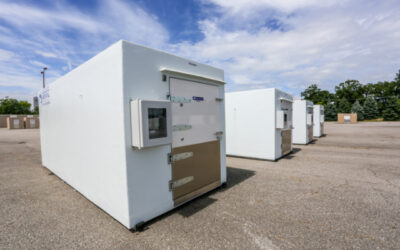
Walk in freezers are large, modular cold storage spaces that can be installed inside or outside a facility. Outdoor units can be as substantial in size as needed, preserving valuable indoor space for operations and providing frozen storage with precise temperature control.
Choosing standalone outdoor walk in freezer rentals gives you the most flexibility, allowing you to add units as needed to quickly scale your storage capacity. When your rush is over, you can simply have unneeded units taken away.
Designed with pharmaceutical needs in mind
Pharmaceutical walk in freezers are engineered to integrate easily with facility monitoring infrastructure, including continuous temperature monitoring systems, remote alarms, and centralized data logging platforms. This integration supports compliance with Good Manufacturing Practice (GMP) and Good Distribution Practice (GDP) requirements by enabling consistent documentation, audit-ready records, and real-time visibility into storage conditions.
In GMP- and GDP-regulated pharmaceutical environments, cold storage equipment is commonly qualified using established protocols such as Installation Qualification (IQ), Operational Qualification (OQ), and Performance Qualification (PQ). But because walk ins are purpose-built for stationary operation and uniform temperature control, they typically deliver more predictable performance during temperature mapping and ongoing monitoring. This can simplify qualification efforts and help reduce the likelihood of temperature excursions that lead to deviations or investigations. Polar Leasing offers pre-validated pharmaceutical walk in cooler and freezer rentals to help make this process as smooth as possible.
Built-in redundancy and contingency planning
Pharmaceutical walk in freezers offer additional risk-mitigation advantages, especially when configured with redundant systems. Dual compressors, backup condensing units, or parallel evaporator configurations allow the system to maintain temperature even if a primary component fails, significantly reducing excursion risk and protecting products during unexpected events.
Engineered for optimum efficiency
If you usually have more temperature-sensitive products on hand than can be stored in a single reach in, choosing a single walk in unit will usually use less energy than deploying multiple reach ins if usage patterns remain consistent. Having fewer systems means fewer monitoring points, fewer alarm configurations, and fewer access events per cubic foot of stored product, which will help limit increases in operational complexity as your facility grows.
And if it’s a Polar Leasing walk in, not only will it have fewer compressors and evaporators running, but its thick polyisocyanurate rigid board insulation will provide a superior barrier against heat and moisture. Its seamless fiberglass surface protects the insulation, providing superior durability, reducing heat gain, and limiting thermal bridging.
Pharmaceutical reach in freezer strengths
Pharmaceutical reach in freezers, including vaccine pharmacy refrigerators, medical laboratory freezers, and under-counter units, are compact, point-of-use cold storage solutions designed for storing small volumes of products. They often include built-in alarms and basic data logging that can be sufficient for meeting compliance requirements on a small scale.
Widely used in pharmacies, clinics, physician offices, and clinical laboratories, these units deliver precise temperature control in a small footprint, which makes them well suited to clinical and pharmacy workflows where staff members need quick, repeated access to temperature-sensitive products.
A better fit for smaller inventories
Reach in freezers are especially valuable when storage volumes are minimal, when a narrow product set requires precise temperatures, and when there is little available space but products need to be kept close to treatment rooms or labs. They can be found in pharmacies and clinics for vaccine storage, low-volume biologic staging, frequently rotated clinical trial samples, and certain research environments.
Reach ins offer several operational advantages. They typically feature microprocessor-based controls with internal temperature sensors and integrated alarm systems capable of maintaining tight temperature ranges, their placement near staff work areas supports efficient workflows, and their relatively low upfront cost and standard electrical requirements make them easy to deploy without specialized infrastructure.
Walk ins vs. reach ins
Because pharmaceutical reach in and walk in freezers have different strengths and weaknesses, each has a role to play in an efficient and compliant cold chain.
When deciding which solution best fits your business, consider the following factors:
- Amount of inventory. Because reach in freezers prioritize convenience over capacity, they’re best suited for small to moderate storage volumes that require frequent and convenient access. Walk ins, in contrast, are designed to support large inventories, staging areas, and centralized storage.
- Your workflow. How you plan to use your stored products can also help you determine which solution to choose. Reach ins are convenient for individual users accessing materials frequently throughout the day, while walk ins are better suited to environments where multiple staff members access inventory in a shared, centralized location.
- Redundancy. While some pharmaceutical reach-in freezers incorporate redundant sensors, controls, or alarm systems, most remain single-circuit refrigeration systems that require backup storage capacity if a mechanical failure occurs. Pharmaceutical walk ins, on the other hand, can be configured with dual compressors, backup condensing units, or parallel evaporator configurations that can take over in the event of failure to significantly reduce the risk of excursions and safeguard product efficacy.
- Your company’s forecast. Is your business poised for growth? Because scale has a major impact on energy efficiency, it’s a good idea to have a plan in place for when you add additional inventory. While a single reach in freezer is efficient for its size, the energy consumption, heat load, and maintenance requirements of multiple units deployed to increase storage space will be far greater than that of a single, well-insulated walk in freezer operating at the same capacity under the same conditions.
- Regulatory and compliance requirements. Your regulatory obligations are another important consideration. In pharmaceutical environments governed by GMP or GDP, cold storage must typically support qualification, monitoring, and audit-ready documentation. While reach-in freezers can meet compliance needs for smaller, point-of-use storage with simpler qualification requirements, the uniform temperature control, centralized monitoring, and predictable performance across larger storage areas that walk-in freezers provide align more closely with regulatory expectations for larger volumes and more complex workflows.
The best choice may be both
Reach in freezers are an excellent choice when cold storage needs are limited, when point-of-use access is critical, when space is constrained, or when a dedicated, high-precision unit is required for a specific product line. Walk in freezers are better suited for centralized pharmaceutical storage, larger inventories, ongoing workflows such as packaging or distribution, and operations that need scalable capacity without added complexity.
For some pharmaceutical facilities, the most effective approach is not a choice of one solution over the other, but a combination of both.
Reach in units can support day-to-day workflows with convenient, localized access, while walk in freezers provide the backbone for bulk storage, staging, and long-term inventory management.
Walk ins also provide a stable and reliable storage environment that can be part of your point-of-use reach in freezer’s documented emergency transfer procedures if a component fails. Together, they can allow organizations to balance efficiency, compliance, and scalability across their entire cold chain.
Matching cold storage solutions to real-world pharma needs
There is no single cold storage solution that fits every pharmaceutical operation. Finding the right approach depends on your inventory volume, workflow, regulatory obligations, and expected growth. High-quality reach in medical freezers are well suited for smaller, point-of-use storage needs, while walk in freezers deliver superior operational value for centralized, high-capacity storage.
Maximize your flexibility with Polar Leasing pharmaceutical walk in cooler and freezer rentals
Need cold storage for your temperature-sensitive pharma products? A Polar Leasing pharmaceutical walk in cooler or freezer can give you the dependable, scalable solution that you’re looking for — at a fraction of the upfront cost. Plus, you get the flexibility of scaling your storage capacity to meet demand with a simple phone call.
Polar Leasing pre-validated pharmaceutical walk ins simplify qualification and reduce the headaches of achieving compliance, providing consistent thermal performance, supporting GMP- and GDP-aligned procedures, and integrating easily with monitoring and alarm systems.
Want protection for emergencies? Choose a walk-in freezer unit with a redundant refrigeration system and you can guard against temperature excursions even if a component fails.
All of our units feature the thick polyisocyanurate rigid board insulation and smooth fiberglass surfaces that make them the most efficient pharmaceutical walk in cooler and freezer rentals on the market.
Contact us today to find out how our pharmaceutical walk in cooler and freezer rentals can help increase efficiency in your operation.